How Legacy Builder Works: Training, Resell Rights and the Sales Process
The easiest way to evaluate Legacy Builder is to split it into three pieces: education, a licensed product to sell, and the marketing system used to find and convert customers.
{DISCLOSURE}1. You purchase access to training
Public sales pages describe multiple training levels covering digital-marketing topics. Higher tiers are commonly presented as including lower-tier material, but current inclusions should be verified before purchase.
2. The purchase may include Master Resell Rights
MRR is a license concept. It can grant a buyer rights to resell specified digital products, subject to the actual license. The license, not the phrase “100% profit”, is the document that matters when deciding what you can legally do.
3. You still need customer acquisition
A prebuilt page or funnel can shorten setup. It cannot make a market choose your offer. Sellers still need traffic, positioning, content or advertising, follow-up and a way to accept payment.
4. Revenue is not the same as profit
Even when a seller retains the sale price under a resale arrangement, business expenses can exist: software, payment processing, domains, advertising, taxes and other operating costs. “Keep the sale” should not automatically be read as “net profit equals the sale price.”
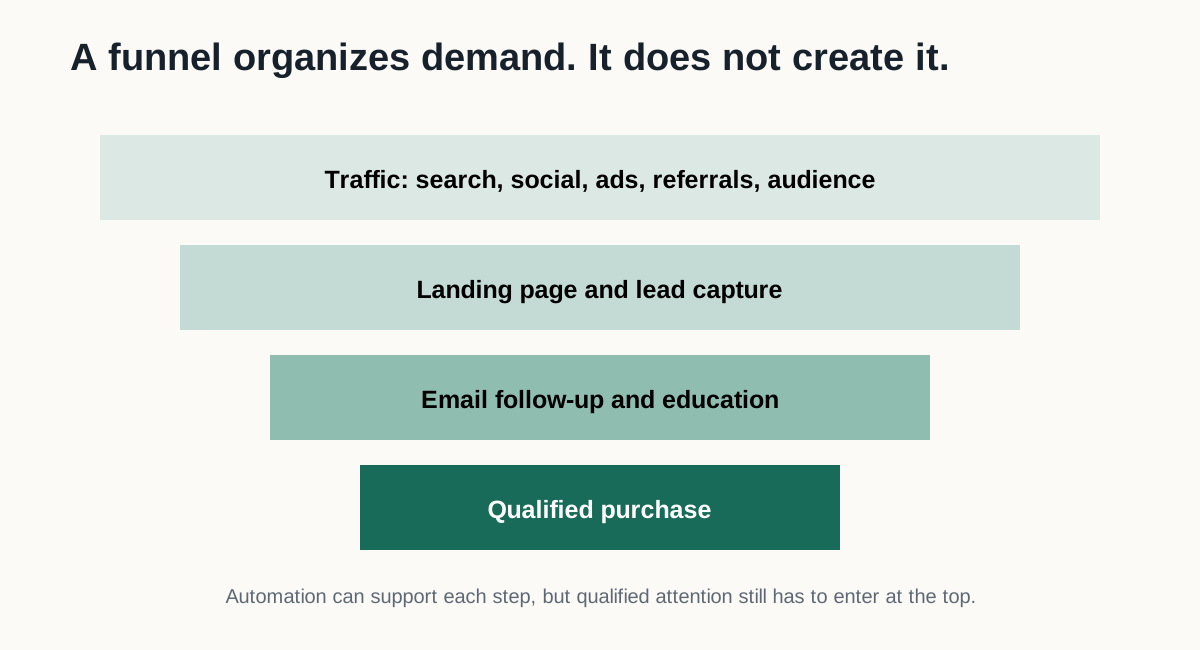
The customer journey from prospect to sale
At a high level, the system still follows a familiar marketing path: attract attention, move an interested person to a page or funnel, capture or continue the conversation, explain the offer, process a purchase, and deliver access. Automation can assist with parts of that sequence, but it does not eliminate the need for a credible traffic source or persuasive communication.
Traffic
Public program descriptions mention social media, free advertising methods, paid advertising, and faceless marketing. Each traffic source has different economics and learning curves. Organic social can require consistent publishing. Paid traffic can generate data faster but exposes a beginner to direct acquisition costs. “Free” traffic still consumes time and attention.
Lead capture and follow-up
Email-list building appears repeatedly in public descriptions of the curriculum. The strategic reason is sound in general: a visitor who does not buy immediately can potentially be educated over time. But email software, deliverability, consent rules, copy, and list quality all affect whether that asset becomes useful.
Conversion
A funnel can organize a sales argument. It cannot force a visitor to accept the proposition. Conversion depends on the match between audience and offer, credibility, price, alternatives, objections, and the quality of the message.
What “automation” can realistically mean
Automation is most useful for repetitive steps such as delivering pages, sending scheduled emails, routing buyers, or presenting a consistent offer. It should not be confused with an autonomous business. Content needs updating, traffic sources change, accounts require maintenance, customers ask questions, and platforms change their rules.
For a prospective buyer, a good test is to list every step between “I purchased the program” and “a stranger paid me.” Any step that requires traffic, judgment, communication, compliance, or optimization is still business work even if software supports it.
Where the tier system affects the model
Public reseller materials describe resale rights as corresponding to the product levels you own. This means the tier choice can affect both what you learn and which products you are permitted to sell. That makes an upgrade decision more complicated than simply choosing a larger potential transaction. You are also deciding how much capital to commit before proving that you can attract and convert an audience.
What you should own versus what the system supplies
Before enrollment, separate portable assets from platform-dependent assets. Skills, an audience relationship, your own brand, and a permission-based email list can potentially remain useful across different offers. A funnel template or licensed product may be valuable, but its usefulness can depend on continued access, license terms, software, and market demand.
That distinction is especially important if your long-term goal is an independent online business rather than simply reselling one program.
What a realistic first 30 days might involve
A useful way to judge the program is to ignore revenue projections and imagine the operational work. A new buyer may need to complete enough training to understand the offer, configure required accounts, learn the funnel, connect a domain or email system, choose a traffic channel, create compliant promotional material, publish consistently, and review what visitors actually do. None of those steps guarantees a sale, but each is a normal part of building a functioning marketing system.
This also explains why two buyers can purchase the same training and have very different experiences. One may already understand content creation and have an audience. Another may be learning copywriting, video, email, analytics, and paid traffic simultaneously. The product can be identical while the starting conditions are not.
Organic traffic versus paid traffic
Organic traffic usually exchanges money risk for time risk. Search content, social publishing, video, communities, and referrals can attract visitors without paying for every click, but they require useful content, consistency, and patience. Paid advertising exchanges some of that waiting for direct financial exposure. It can produce faster feedback, but a beginner can lose money while learning targeting, creative, landing pages, tracking, and conversion economics.
Neither route is automatically superior. The relevant question is whether you have a repeatable acquisition method whose cost and workload fit the margin available on the product you are selling.
Why an email list is useful but not magical
Email can turn a one-time visit into an ongoing relationship. A visitor who is not ready to buy can receive educational follow-up, comparisons, answers to objections, and future offers. That makes list building strategically useful across many online businesses, not just MRR.
But the list must come from somewhere. A funnel with excellent automation but no qualified traffic has little to automate. Likewise, a large list of poorly matched subscribers can be less valuable than a smaller audience with a clear reason to care about the topic.
Payment processing and business responsibility
Before selling any digital product, understand who is merchant of record, who processes payments, who handles chargebacks, what fees apply, and what obligations you have to customers. Promotional language about retaining a sale price does not answer those operational questions. They affect cash flow, customer experience, recordkeeping, and actual profit.
Ask for the current instructions for the exact Legacy Builder level and selling setup you plan to use. Do not assume that a screenshot or tutorial from another seller represents your final configuration.
How to judge whether the system is working
Revenue is a late-stage metric. Earlier signals can help diagnose the system: whether content reaches the intended audience, whether visitors click through, whether landing pages hold attention, whether leads opt in, whether emails are opened and clicked, and whether qualified prospects reach the checkout. These measures do not guarantee eventual profitability, but they can reveal where a funnel is failing.
A seller who receives no traffic has a different problem from one who receives traffic but no opt-ins. Someone with opt-ins but no purchases has a different problem again. Treating all three as “the program doesn't work” prevents useful diagnosis.
What can transfer to another business?
One of the strongest ways to assess educational value is portability. Skills such as audience research, copywriting, email marketing, analytics, content strategy, landing-page design, and basic paid acquisition can potentially apply to many legitimate products and services. A specific resale license is narrower because its value depends on that product, its terms, and continuing demand.
If you are buying primarily to learn, prioritize the parts of the curriculum that remain useful even if you later stop promoting Legacy Builder. If you are buying primarily for resale rights, scrutinize the economics and competition more heavily.
Common misconceptions about the model
“The funnel finds customers for me”
A funnel receives and processes attention. It is not itself a traffic source unless the package also includes a separate acquisition mechanism.
“Automation means passive income”
Automation can reduce repetitive work. It does not eliminate content, traffic, customer service, optimization, compliance, or platform maintenance.
“A higher ticket means more profit”
A larger sale can provide more gross revenue, but profit depends on acquisition cost, refunds, processing, software, taxes, and other expenses.
“If someone else succeeded, I can reproduce it”
Another seller's outcome may depend on audience size, experience, timing, budget, content skill, or other variables you do not share. Use examples to generate questions, not forecasts.
A practical readiness test
- Can you explain the product without relying on an income claim?
- Do you know which audience you want to reach?
- Have you chosen one traffic channel you are willing to learn deeply?
- Can you afford the purchase and setup without needing quick sales to recover the money?
- Have you read the current license and refund terms?
- Are you willing to create content, communicate with prospects, and measure results?
- Would the skills still be valuable if you eventually promoted a different product?
If several answers are no, more preparation may be more valuable than buying a higher tier immediately.