Master Resell Rights Explained: What MRR Does, and Doesn’t, Give You
Master Resell Rights are contractual permissions attached to a digital product. They can make product sourcing easier, but they do not automatically create differentiation, traffic or sales.
MRR vs. affiliate marketing
| MRR | Affiliate marketing |
|---|---|
| You operate under a resale license for a product. | You refer buyers to a merchant under an affiliate agreement. |
| Your rights depend on the product license. | Your rights and commission depend on the affiliate terms. |
| You may have more responsibility in the selling process. | The merchant commonly controls checkout and fulfillment. |
The attraction of MRR
Creating a useful digital product from scratch takes research, production and support. A licensed product can reduce that initial workload. For a beginner, that may create a faster path to practicing positioning, content, email and sales skills.
The trade-off
If many sellers can offer the same core product, differentiation shifts toward brand, audience, trust, bonuses, service and marketing execution. That can make the marketing challenge more important, not less.
Read the actual license
Do not assume every MRR product permits the same actions. Check rules around pricing, editing, branding, sublicensing, refunds, marketplaces and what rights your own customer receives.
MRR is a license, not a universal rulebook
“Master Resell Rights” is a category of licensing arrangement, not one standardized legal package that means exactly the same thing for every product. The actual written license determines what a buyer can resell, whether downstream customers receive resale rights, whether the content can be edited or rebranded, where it may be sold, and what pricing restrictions apply.
That is why a buyer should avoid relying on shorthand descriptions such as “you own it” or “100% profit.” Those phrases can be useful marketing summaries, but they do not replace the license terms or an accounting of business expenses.
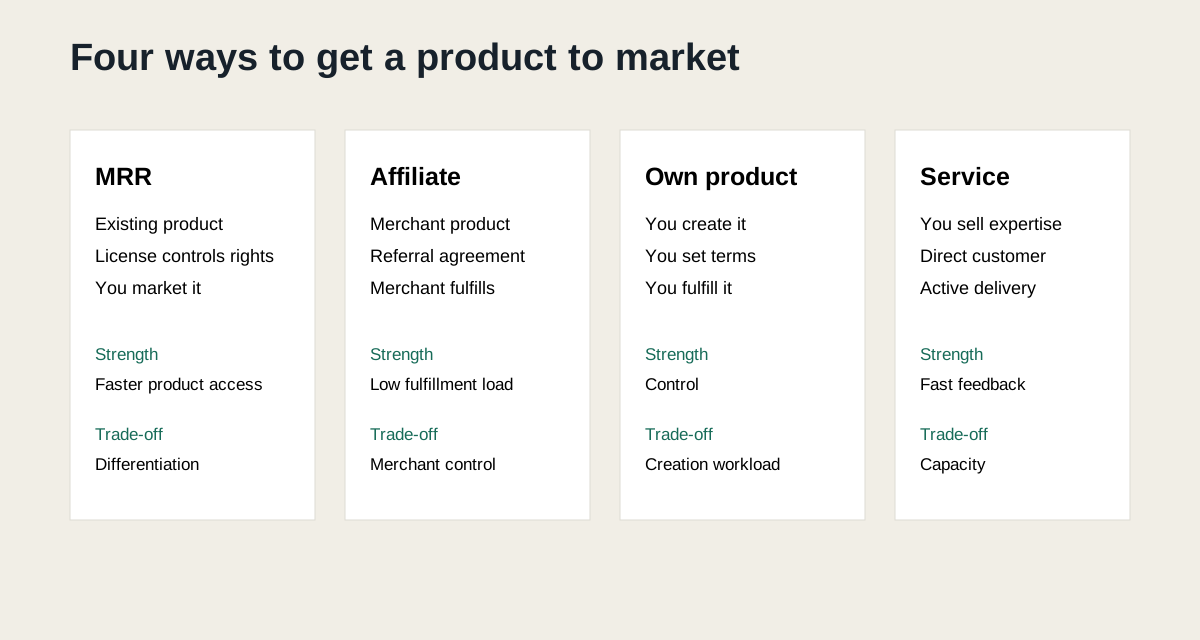
MRR, PLR, affiliate marketing, and creating your own product
| Model | Core idea |
|---|---|
| Master Resell Rights | You receive specified resale permissions under a license. The exact downstream rights depend on that license. |
| Private Label Rights | PLR licenses often permit some form of modification or rebranding, but permissions vary widely and must be checked product by product. |
| Affiliate marketing | You refer a customer to another merchant and earn according to an affiliate agreement. You normally do not become the product licensor. |
| Your own product | You create and control the underlying intellectual property, subject to any third-party material or tools used in production. |
Why beginners are attracted to resale products
Product creation is difficult. A new creator must identify a problem, research the audience, build something useful, package it, price it, create sales material, and support customers. A licensed product can remove a large part of that initial production burden and let the buyer practice marketing sooner.
The trade-off is control. You may not control the core product, the license, the reputation surrounding it, or how many other sellers enter the market. A shortcut in product creation can therefore increase the importance of positioning and audience development.
The saturation problem
When many independent sellers have rights to promote the same or similar product, the product itself becomes less distinctive. That does not prove nobody can sell it. It does mean a seller should have an answer to a basic customer question: “Why should I buy through you?”
Possible differentiation can include a trusted niche audience, genuinely useful education around the product, service, original bonuses that comply with the license, or a broader brand that is not dependent on one resale offer. If the only differentiator is repeating the same income claim more aggressively, the business becomes fragile.
License due diligence
- Identify exactly which files, courses, or products the license covers.
- Check whether you may edit, rename, rebrand, bundle, discount, or give away the product.
- Check whether your customer receives resale rights and, if so, under what conditions.
- Check marketplace, advertising, and geographic restrictions.
- Understand who is responsible for support, refunds, taxes, payment disputes, and product delivery.
- Save a copy of the license that applied when you purchased.
Is MRR inherently a pyramid scheme?
No label should be applied solely because a product carries resale rights. The relevant questions are how compensation is generated, what genuine product or service is being sold, whether participants are paid for recruiting, and how the specific arrangement operates. Legacy Builder promotional pages state that sellers earn from direct product sales rather than an upline/downline structure. Critics argue that the repeated resale of the same business-training product can feel recruitment-like in practice. Those are different claims and should not be collapsed into a slogan.
If you need a legal classification of a particular compensation arrangement, consult the applicable regulator or a qualified professional rather than relying on social-media labels.
How MRR changes the usual product-creation equation
Traditional digital-product businesses place most early effort on creating the asset. MRR moves some of that effort upstream to the original creator and gives licensed sellers a faster starting point. The seller can then concentrate on audience building and distribution. That is the genuine operational appeal of the model.
The corresponding weakness is that product ownership and product control are not the same as having resale permission. If the license limits modification or many sellers distribute substantially the same material, the seller has fewer product-level levers for differentiation.
Price control matters
Some resale licenses specify a minimum price or otherwise restrict how the product may be offered. That can protect perceived value, but it can also remove discounting as a competitive tool. Other licenses may allow bundles or bonuses but restrict editing. The only reliable answer is the current license for the specific product.
Do not assume that practices you see other sellers using are permitted. A seller can misunderstand a license, use an older version, or simply ignore a restriction.
Customer expectations do not disappear with a license
A buyer usually does not care that product creation was outsourced through a resale license. They care whether the product solves the problem they were promised it would solve. That means accurate descriptions, clear expectations, functioning delivery, and appropriate support still matter.
If your marketing implies a level of support, access, customization, or outcome that the underlying product does not provide, having resale rights does not cure the mismatch.
Why audience ownership can be more valuable than product access
Products and offers can change. An audience that trusts your analysis can potentially follow you from one relevant product to another. This is one reason a durable MRR strategy should not consist only of reposting a supplied sales page. Original educational content, a recognizable brand, useful email communication, and a defined niche can become assets independent of one license.
This authority-site approach follows the same principle. Informational pages answer questions before asking for a commercial action, while the review page handles the purchase decision. The goal is to earn the click rather than merely repeat the merchant pitch.
MRR and business risk
Every business model shifts risk rather than eliminating it. Creating your own product creates development risk. Affiliate marketing creates merchant and commission risk. MRR reduces initial product-development work but introduces license, differentiation, reputation, and saturation risk. Paid traffic introduces direct acquisition-cost risk. Organic traffic introduces time and platform-distribution risk.
A useful decision compares which risks you are equipped to manage, not which model sounds easiest in promotional material.
Questions about downstream resale rights
One feature often associated with Master Resell Rights is the ability for a customer to receive resale rights as well. That can create a chain of independent sellers, but the exact rights depend on the license. Ask whether your buyer receives MRR automatically, whether you must provide a license file, whether pricing rules carry forward, and whether there are restrictions on marketplaces or advertising.
Those details affect both the value proposition and the competitive environment. If every new buyer can immediately become another seller of the same product, customer acquisition becomes an increasingly important skill.
Accounting for actual margin
Suppose a digital product sells for a stated price and the reseller receives the customer payment. It is still incorrect to call the entire amount profit without considering expenses. Payment processing, software, domains, email systems, advertising, creative production, refunds, taxes, and professional services can all reduce the economic return.
For that reason, evaluate an MRR offer with a simple business model: expected selling price, realistic customer-acquisition cost, variable transaction costs, recurring software costs, refund assumptions, and the time required to operate the system. Avoid filling the spreadsheet with an assumed sales volume simply because a promoter shows a successful example.
When MRR can be a reasonable learning vehicle
A ready-made product can give a beginner something concrete to market while learning. Instead of spending months creating a course before discovering whether they enjoy promotion, the buyer can practice content, email, funnels, positioning, and analytics around an existing offer. That can be educational even if the product never becomes a long-term business.
The key is to price that learning experience realistically. If the educational value alone does not justify the cost for you, then the purchase decision becomes dependent on resale success, which is inherently uncertain.
When to avoid an MRR offer
- You want exclusive ownership of the core product or intellectual property.
- You are uncomfortable competing with sellers offering substantially the same material.
- You do not want to market or create audience-facing content.
- You need predictable or guaranteed income to justify the purchase.
- You have not been able to inspect the current license and transaction terms.
- The only part of the offer you value is the possibility of reselling it to someone else.
None of these points makes MRR universally good or bad. They identify situations where the model conflicts with the buyer's objectives.