Legacy Builder Alternatives: 4 Different Ways to Build Digital Income Skills
The most useful “alternative” is not necessarily another MRR course. First choose the business model you want, then choose training and tools.
1. Conventional affiliate marketing
You publish useful content and refer buyers to third-party products for a commission. You avoid creating or fulfilling the underlying product, but you depend on merchant terms and commission structures.
2. Create your own digital product
You control the product and positioning, which can improve differentiation. The trade-off is substantially more work in research, creation, updates, support and delivery.
3. Skills-first digital marketing education
You can buy training that focuses on SEO, email, paid acquisition, content or conversion without tying the curriculum to reselling the same course. This can be a better fit if transferable skill development is the primary goal.
4. Free resources + a small live project
For budget-sensitive beginners, reputable documentation, platform education and hands-on experimentation can teach fundamentals. The cost advantage is clear; the downside is less structure and more work separating good information from noise.
Where Legacy Builder fits
Legacy Builder occupies a hybrid position: education plus a ready-made resale opportunity. That may appeal to someone who values structure and does not want to create a first product. It is less compelling if your priority is differentiation or if you mainly want skills you can apply to many unrelated businesses.
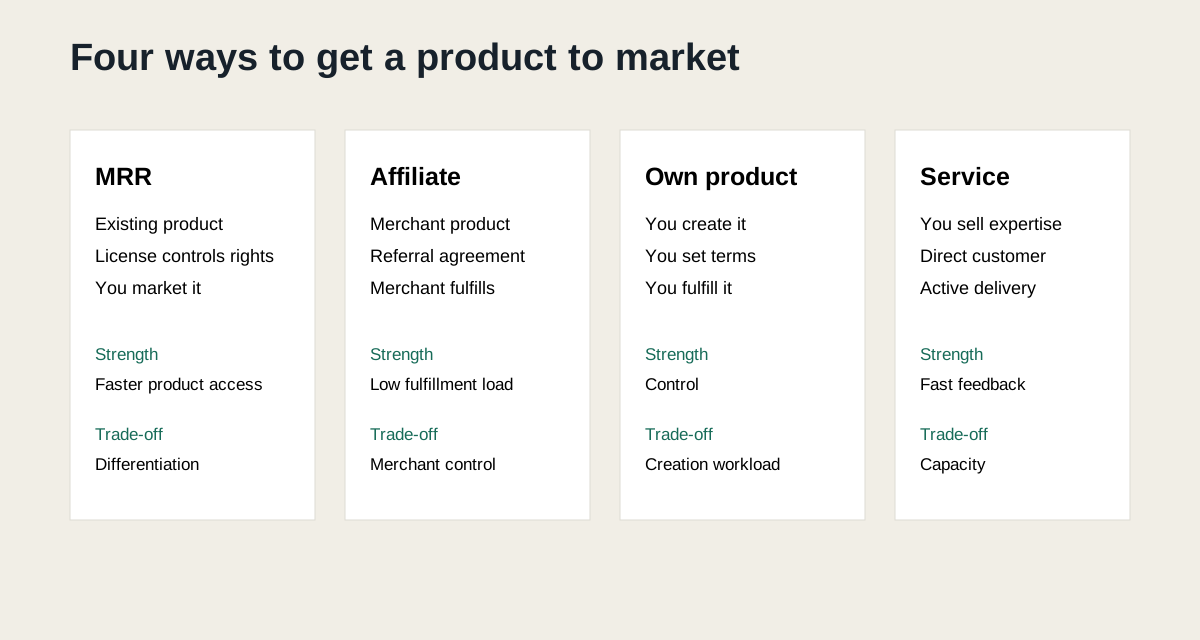
Choose the model before choosing the course
Many people compare Legacy Builder with another named course when the more important comparison is between business models. If you dislike selling opportunity-oriented education, another MRR course may reproduce the same objection under a different brand. If you dislike product creation, building your own course may create the opposite problem. Start with the kind of work you are willing to do repeatedly.
| Path | Main advantage | Main trade-off |
|---|---|---|
| Legacy Builder / MRR | Training plus an existing product and resale mechanism. | Less control and differentiation; demand still has to be created. |
| Affiliate marketing | No need to create or fulfill the merchant's product. | Merchant controls commissions, program access, and much of the customer experience. |
| Own digital product | Maximum control over positioning, pricing, and intellectual property. | Research, creation, support, and updates are your responsibility. |
| Service business | You can monetize a skill directly before building a product. | Delivery is often time-intensive and less passive. |
| Free learning + project | Lowest education cost and strong hands-on feedback. | Less structure, no bundled community, and more self-direction required. |
Alternative 1: conventional affiliate publishing
This model can suit someone who enjoys research, content, comparison, SEO, video, newsletters, or audience building but does not want to be the merchant. You can promote multiple relevant products instead of tying the entire business to one resale license. The downside is dependence on third-party programs. Commissions can change, accounts can be closed, and the merchant controls conversion after the referral.
Alternative 2: build a small original product
An original template, guide, mini-course, database, tool, or workshop can begin much smaller than a large flagship course. The advantage is differentiation and ownership. The disadvantage is that you must discover what customers actually need and create something good enough to earn trust.
For some beginners, this path is slower at the start but produces a stronger long-term asset because the product, positioning, customer feedback, and brand are yours.
Alternative 3: sell a service first
A service business can be a useful bridge between learning marketing and building scalable products. Copywriting, editing, design, local lead generation, email setup, content production, or other legitimate skills can be sold directly. Client work provides fast feedback about what customers value, although it is usually less automated and requires delivery capacity.
Alternative 4: skills-first education
If your real goal is to learn SEO, email marketing, paid acquisition, analytics, copywriting, or social content, compare training based on curriculum quality rather than resale potential. Ask whether the skill can be applied to many products and businesses. Portability reduces dependence on the continued popularity of one offer.
Alternative 5: free education with a real project
Major advertising, analytics, email, ecommerce, and search platforms publish extensive documentation. Free material is not automatically better, and navigating it can be inefficient. Its advantage is that you can test your motivation before making a large course purchase. Build a small site, newsletter, content channel, or product page and see which skills you actually need.
Who should prefer which path?
- Choose an MRR-style path if you specifically value a packaged product plus training and accept the differentiation challenge.
- Choose affiliate marketing if you want to build an audience and recommend multiple third-party products.
- Create your own product if control and differentiation matter more than speed.
- Sell a service if you want direct market feedback and are comfortable exchanging expertise for client revenue.
- Start free if you are still testing whether you enjoy digital marketing enough to invest heavily in training.
How to compare the cost of different paths
Course price is only one part of cost. A free learning path can consume large amounts of time. An original product may require design, software, research, or contractor expenses. Affiliate marketing can be inexpensive to start but may require months of content before meaningful traffic arrives. A service business can generate revenue earlier but consumes delivery time.
Compare each path using the same categories: education cost, software, traffic acquisition, time to competence, control over the offer, ongoing workload, dependence on third parties, and how transferable the resulting assets are.
Which path builds the strongest long-term asset?
There is no universal answer, but ownership matters. An original product, an audience relationship, a useful website, an email list built with permission, and transferable skills can retain value even when one offer changes. An affiliate relationship or resale license can disappear or become less attractive because the merchant, license, price, or market changes.
This does not mean you must create everything yourself. It means your strategy should ideally accumulate assets that are not all controlled by the same third party.
Affiliate marketing as an alternative
Affiliate marketing is often a closer alternative than another MRR program because it preserves the “sell something you did not create” advantage while changing the commercial relationship. The merchant generally owns the product, checkout, fulfillment, and customer experience. The publisher earns a stated commission for qualifying referrals.
The benefit is flexibility. A useful publication can compare several products and change recommendations as the market changes. The weakness is control: commissions, attribution windows, program terms, and merchant acceptance can change. A durable affiliate business therefore depends more on owning useful content and audience access than on any one program.
Creating your own digital product
Building an original product creates more work before launch but can produce stronger differentiation. You can focus on a narrow problem, incorporate customer feedback, set your own positioning, and improve the product over time. You are also responsible for quality, support, delivery, legal compliance, and refunds.
A beginner does not need to start with a huge course. A focused template, calculator, workshop, guide, dataset, or small training product can test whether customers will pay for the solution before you invest in a large curriculum.
A service-first path
Services are sometimes overlooked in “passive income” discussions because they require active delivery. They can nevertheless be one of the clearest ways to learn what customers value. A person learning email marketing might set up newsletters for small businesses. Someone learning content could offer editing or research. The client conversation supplies immediate market feedback.
Over time, repeated service work can reveal opportunities for templates, training, software, or productized services. That creates a path from active income toward more scalable assets without assuming a resale product will generate demand automatically.
Skills-first paid education
Paying for education can be rational when structure, feedback, community, or expert sequencing saves substantial time. The key is to buy the skill you actually need. A course about copywriting, analytics, SEO, paid media, email, or conversion can potentially support many business models.
When comparing any course with Legacy Builder, ask whether the curriculum is designed primarily to teach a portable capability or primarily to help buyers sell the same offer. Neither answer automatically disqualifies it, but they represent different kinds of value.
Free resources are an alternative, not automatically a substitute
Free information is abundant but fragmented. A beginner can spend weeks consuming tutorials without building anything. Structured paid training can solve that sequencing problem. On the other hand, paying for a course does not force implementation.
A useful compromise is to complete one small real project before a large purchase. Build a simple landing page, publish ten useful pieces of content, start a small email list, or try to sell a modest original service. The friction you encounter tells you what education would actually help.
Decision matrix
| If your priority is... | Consider first... |
|---|---|
| Fast access to an existing digital product plus structured training | Legacy Builder or another carefully vetted licensed-product model. |
| Building an audience around several third-party products | Conventional affiliate publishing. |
| Maximum differentiation and product control | An original digital product. |
| Getting paid while learning a market | A focused service business. |
| Developing a portable marketing specialty | Skills-first education plus a live project. |
| Minimizing financial commitment while testing motivation | Free primary-source learning plus hands-on implementation. |
What we would not optimize for
Do not choose a model merely because a social post shows the largest possible transaction. High-ticket products can be harder to sell. Low-cost products can require more volume. Recurring revenue can involve retention work. Services can have excellent margins but limited capacity. Every attractive headline hides an operational trade-off.
Choose the path whose day-to-day work you are willing to perform and whose risks you understand. That is a stronger foundation than choosing whichever offer currently has the most dramatic income marketing.
Our comparison conclusion
Legacy Builder's distinctive proposition is convenience: structured marketing education combined with an existing product and resale rights. Its trade-offs are dependence on a specific license and offer, competition among sellers, and the continuing need to generate demand. For someone who specifically values that package, it can deserve consideration.
For someone whose priority is a durable independent asset, conventional affiliate publishing, an original product, a service-first business, or skills-first education may create more flexibility. The right alternative depends less on which course has the strongest sales page and more on what you want to own and what work you are prepared to do.